
About Time
About Time
Investigating our grandfather clock
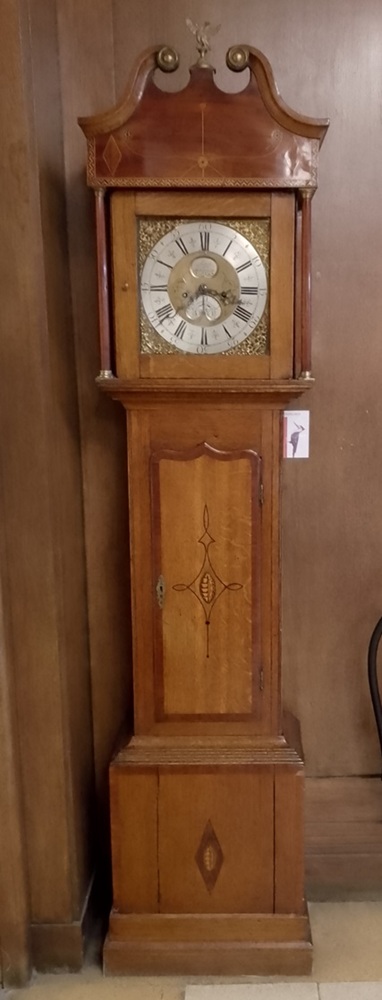
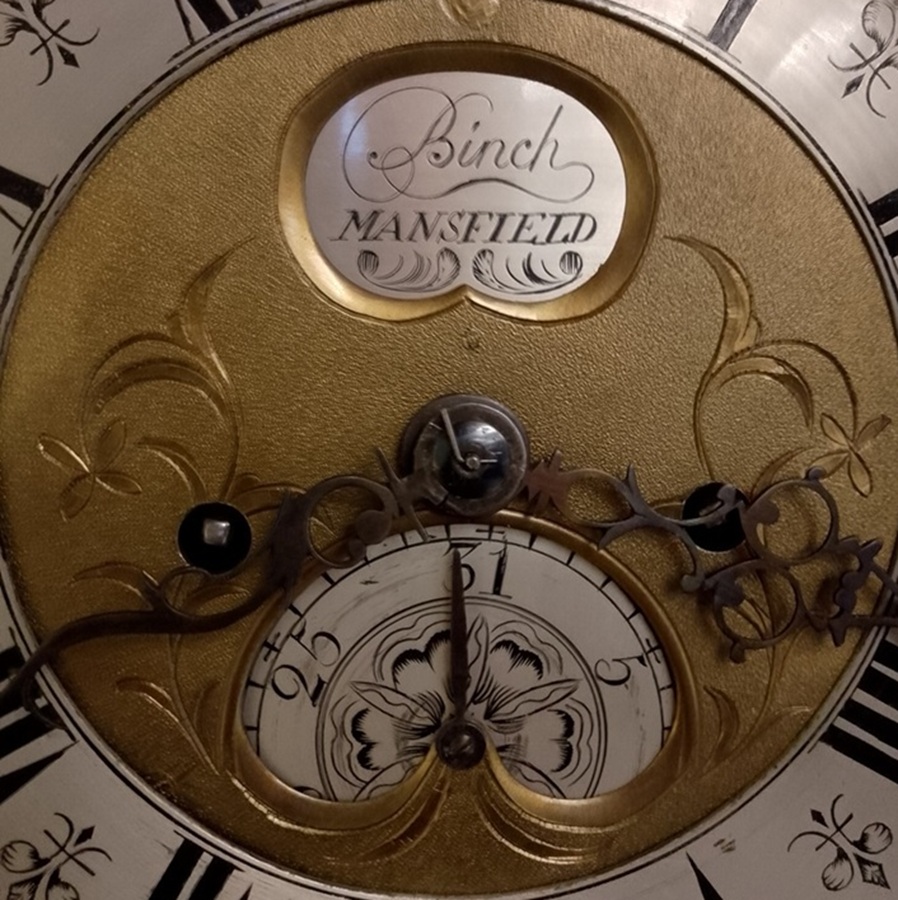
The move to Mansfield Museum brought the clock close to home. It was made between 1740 and 1750 by Thomas Binch, who was a clockmaker in Mansfield. Thomas was born around 1688, and lived to be 84 years old. He married twice, first to Lydia Oldfield in 1710 and then, following Lydia’s death, to Elizabeth Timmons in 1750. Thomas died in 1769.
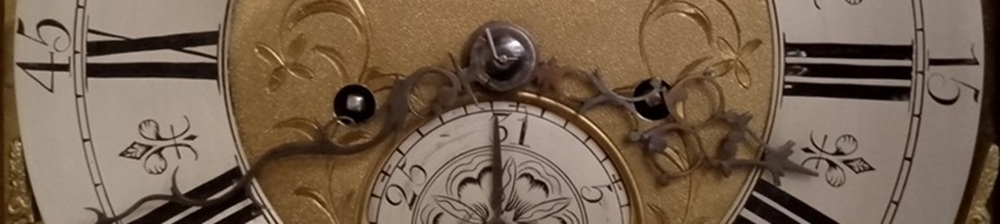
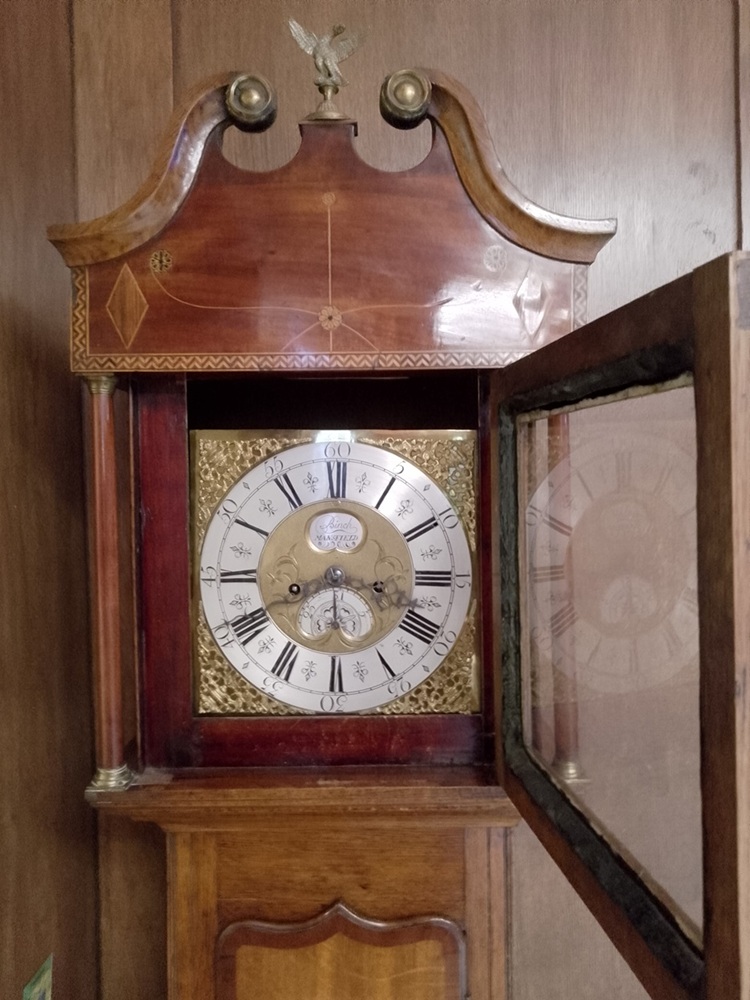
The maker’s name is shown on the clock face. The clock dial is of steel, with Roman numerals and decorative flourishes between them. The two main clock hands are elaborate, openwork, brass pointers. The centre of the clock dial has a circular brass plate, engraved with more decorative designs. The brass plate has two oval openings to display steel fittings behind. The top one is a maker’s plate reading “Binch MANSFIELD” and the bottom one is a small dial for indicating the date. The decoration continues in the spandrels – the corners between the round clock dial and the square of the case. These are more openwork brass, with a little urn included in the design.
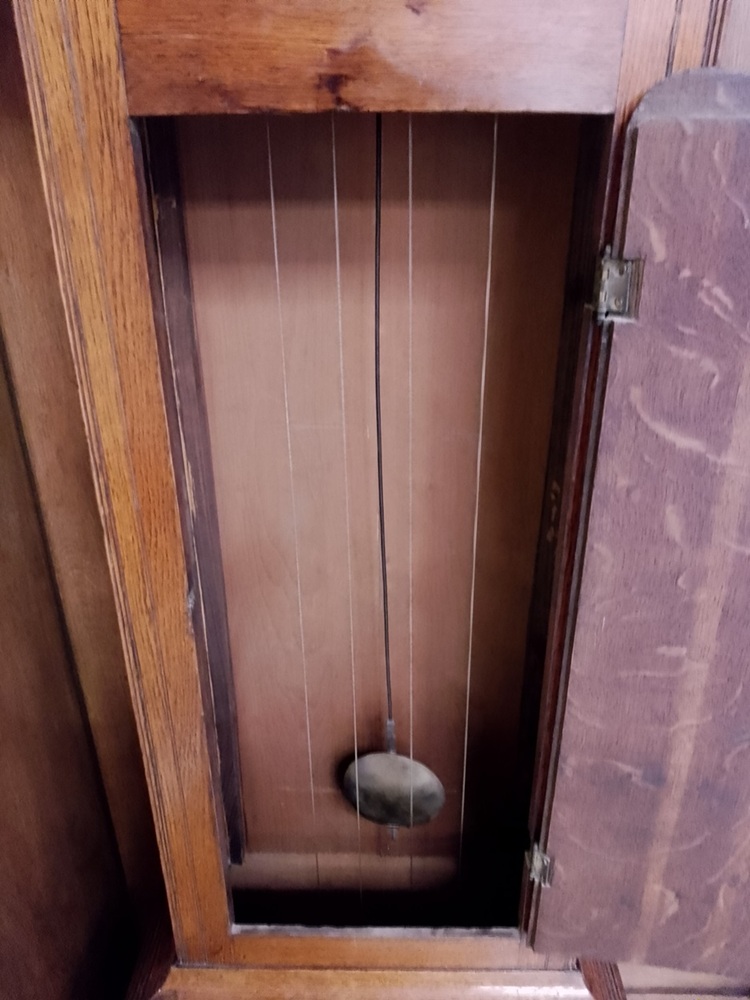
When the clock is opened, the workings become visible. The clock mechanism is of brass, and it is moved by two heavy lead weights, which hang down into the body of the case. One weight controls the time, and the other controls a chime which rings on the hour. There is also a pendulum, whose swing regulates the mechanism.
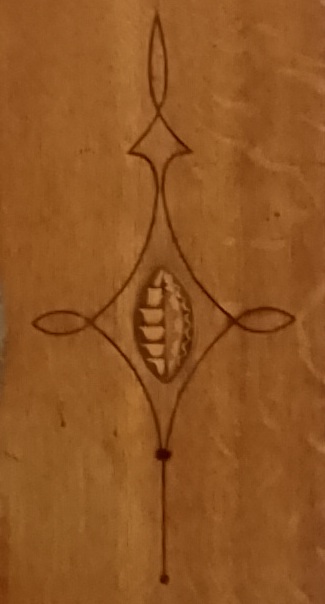
The clock is housed in a tall wooden case, decorated with designs picked out in darker and lighter wood, which is inlaid into the oak of the case.
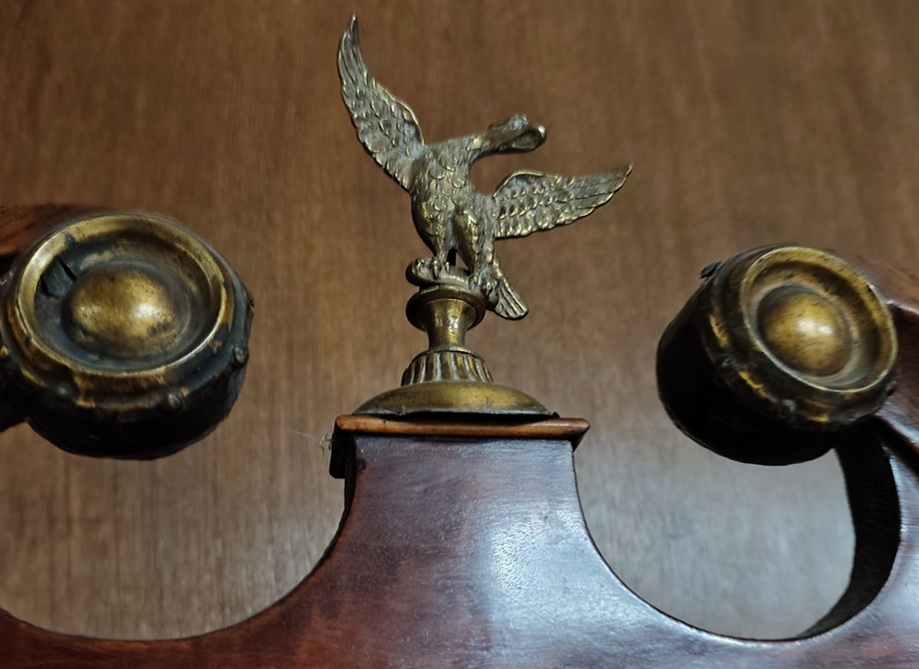
The top of the case has a carved, double scroll of wood, with a small brass eagle ornament in between. The case is almost as decorative as the clock face!
However, there are signs that this is not the original case for the clock. Opening the cover of the clock dial reveals that the mechanism doesn’t actually fit very well into the case – there is a strange gap above the dial and it isn’t seated completely securely.
The style of the case is also at odds with the date of the clock’s manufacture. Long-case clocks of the 1740s more commonly had simpler oak cases without the embellishments, like this example from the British Museum:
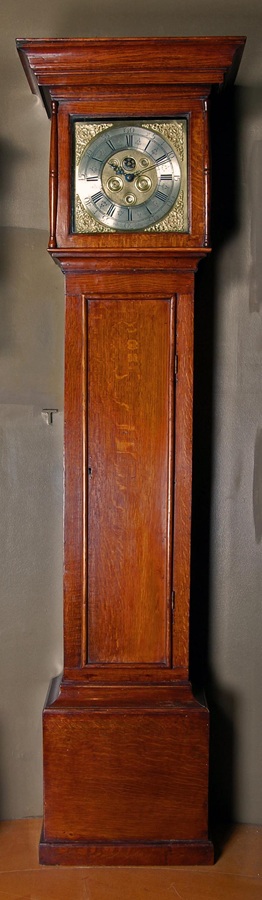
© The Trustees of the British Museum. Shared under a Creative Commons Attribution-NonCommercial-ShareAlike 4.0 International (CC BY-NC-SA 4.0) licence.